
About the Client
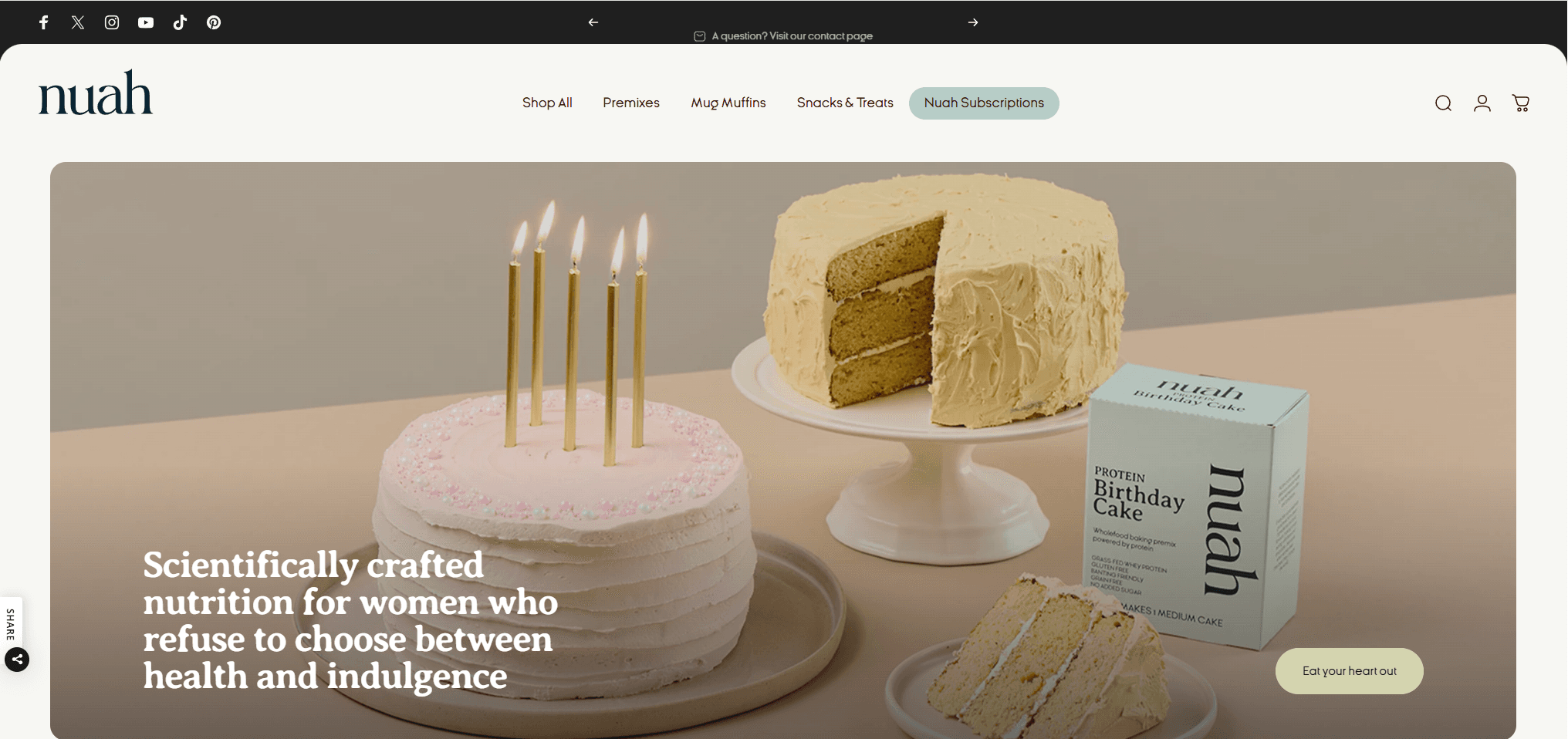
Nuah is a South African wellness and nutrition brand producing scientifically crafted, lab-tested food products designed for health-conscious consumers who refuse to compromise on taste. Their product range includes breakfasts, snacks, and baking mixes—all doctor-balanced to provide sustained energy while maintaining an indulgent eating experience.
Operating at the intersection of nutrition science and culinary enjoyment, Nuah has built a loyal customer base seeking healthier food options that actually taste good. As a direct-to-consumer brand, their eCommerce platform serves as the primary sales channel, making website performance and reliability critical to business success.
With a growing product line and an expanding customer base increasingly interested in subscription options for regular product delivery, Nuah needed an eCommerce infrastructure that could scale with their ambitions.
The Challenge: Outgrowing WordPress & WooCommerce
When Nuah approached us, they faced challenges common to growing eCommerce businesses that have outgrown their initial platform choice.
Platform Scalability Concerns
Growing Pains with WooCommerce:
Nuah’s existing WordPress and WooCommerce setup had served them well in the early stages, but as the business grew, limitations became increasingly problematic:
Performance Issues: As traffic and product catalog size increased, the site’s performance deteriorated. Page load times slowed, particularly during product launches or promotional campaigns when traffic spiked. WordPress sites, especially those running WooCommerce with multiple plugins, often struggle under increased load without significant server investment.
Maintenance Overhead: WordPress and WooCommerce require ongoing maintenance—plugin updates, theme compatibility checks, security patches, and regular troubleshooting. For a small team focused on product development and customer acquisition, this technical overhead was becoming unsustainable.
Plugin Dependency: To achieve necessary functionality, the site relied on multiple plugins working together. This created:
- Compatibility issues when updates occurred
- Performance degradation from plugin bloat
- Security vulnerabilities from outdated extensions
- Unpredictable behavior when plugins conflicted
Checkout Reliability: Intermittent checkout issues were causing cart abandonment and lost revenue. For an eCommerce business, unreliable checkout is a critical problem that directly impacts the bottom line.
Subscription Management Challenges
Nuah recognized that recurring revenue through subscriptions would be key to sustainable growth. Customers wanted the convenience of regular product deliveries without repeatedly placing orders.
WooCommerce Subscription Limitations:
While WooCommerce supports subscriptions through plugins, the implementation presented challenges:
Complex Setup: Subscription functionality required additional plugins, custom configuration, and careful management. The system felt fragile and required constant attention.
Customer Experience Issues: Managing subscriptions from the customer side was less intuitive than it should be. Customers had difficulty updating delivery frequencies, skipping shipments, or managing payment methods.
Technical Reliability: Subscription processing relied on WordPress cron jobs and plugin coordination. This created:
- Missed renewal charges
- Failed payment processing
- Inconsistent subscription renewals
- Customer service headaches from technical glitches
Scalability Concerns: As the subscription customer base grew, the WooCommerce subscription system would require increasing technical resources and management time.
Business Growth Limitations
Beyond immediate technical concerns, the WordPress/WooCommerce setup was limiting Nuah’s growth potential:
Integration Complexity: Connecting marketing tools, analytics platforms, and third-party services required custom development or multiple plugins, adding to the maintenance burden.
Mobile Experience: While responsive, the mobile shopping experience wasn’t as smooth or conversion-optimized as modern Shopify themes provide out of the box.
Operational Efficiency: Managing products, processing orders, and handling customer service took more time than necessary due to interface limitations and workflow inefficiencies.
Cost Structure: Between hosting, premium plugins, security services, and maintenance requirements, the total cost of ownership for the WooCommerce setup was higher than expected—and growing as the business scaled.
The Solution: Strategic Shopify Migration with Custom Subscription Infrastructure
We executed a comprehensive WooCommerce to Shopify migration focused on preserving business continuity while establishing a more scalable, reliable eCommerce foundation.
Migration Strategy & Planning
Pre-Migration Assessment:
Before touching any live data, we conducted a thorough audit:
Data Inventory:
- Catalogued all products, variants, and SKUs
- Documented customer accounts and order history
- Identified subscription customers requiring special handling
- Reviewed existing content (pages, blog posts, images)
- Mapped URL structures for redirect planning
Business Continuity Planning:
- Identified low-traffic migration window
- Created detailed rollback procedures
- Planned for parallel testing before cutover
- Developed communication strategy for customers
Shopify Configuration Strategy:
- Selected appropriate Shopify plan for business needs
- Identified theme matching brand requirements
- Planned app ecosystem for necessary functionality
- Designed information architecture for improved navigation
Platform Migration Execution
Product Migration:
We carefully migrated Nuah’s entire product catalog to Shopify:
Product Data Transfer:
- All product information (titles, descriptions, specifications)
- Complete image libraries with proper organization
- Product variants (sizes, flavors, package options)
- Pricing information and compare-at pricing
- Inventory levels and SKU data
- Product categorization and collections
SEO Preservation:
- Maintained URL structures where possible
- Created 301 redirects for changed URLs
- Migrated meta titles and descriptions
- Preserved product page optimization
- Ensured no broken links post-migration
Customer & Order Migration:
Preserving customer relationships was critical:
Customer Account Transfer:
- Customer contact information and profiles
- Order history for each customer
- Customer tags and segmentation data
- Saved addresses and preferences
This ensured customers could log in to the new Shopify site with their existing credentials and see their complete purchase history.
Order History: Historical order data migrated for business continuity and customer service purposes, allowing the team to reference past purchases and maintain customer service quality.
Shopify Theme Setup & Optimization
Theme Selection & Customization:
We selected and customized a Shopify theme optimized for health and wellness brands:
Brand Alignment: The theme was customized to reflect Nuah’s brand identity—clean, modern, science-backed yet approachable. Color schemes, typography, and visual elements matched their existing brand guidelines.
User Experience Design: Optimized the shopping experience for conversion:
- Clear product categorization and filtering
- Improved product page layouts emphasizing benefits
- Streamlined navigation reducing clicks to purchase
- Mobile-optimized browsing and checkout
- Fast-loading pages with optimized images
Performance Optimization: From day one, we configured the site for speed:
- Optimized images throughout
- Clean code implementation
- Minimal app usage to reduce bloat
- Proper caching configuration
- CDN delivery for global performance
Conversion Optimization: Built in features to drive sales:
- Prominent add-to-cart and checkout buttons
- Trust signals and security badges
- Customer reviews integration
- Product recommendations
- Newsletter signup integration
Custom Subscription Domain Implementation
The most technically sophisticated aspect of this project was building dedicated subscription infrastructure.
Subscription Strategy:
Rather than relying solely on Shopify’s native subscription apps, we implemented a custom subscription domain—a separate environment dedicated to managing recurring orders.
Why a Custom Subscription Domain:
Clean Separation: Keeping subscription logic separate from the main storefront provided:
- Better performance on the main site
- More control over subscription functionality
- Clearer customer experience
- Easier troubleshooting and management
Reliability: Dedicated subscription infrastructure ensured:
- Consistent renewal processing
- Reliable payment handling
- Better uptime for subscription management
- Reduced risk of conflicts with other functionality
Scalability: As subscription customer base grows, the infrastructure can scale independently without impacting the main storefront.
Customer Experience: Subscription customers received a streamlined management portal where they could:
- View upcoming deliveries
- Adjust delivery frequency
- Skip or reschedule shipments
- Update payment methods
- Manage product preferences
- Pause or cancel subscriptions
Technical Implementation:
The custom subscription domain integrated with Shopify while maintaining independent functionality. This required careful planning around:
- Customer authentication between systems
- Order synchronization and inventory management
- Payment processing coordination
- Email notification systems
- Customer support tool integration
Payment & Checkout Configuration
Payment Gateway Setup:
Configured payment processing optimized for South African customers:
- Local payment gateway integration
- International payment support for expansion
- Secure checkout with PCI compliance
- Fraud detection and prevention
- Multiple payment method options
Checkout Optimization: Shopify’s native checkout is conversion-optimized, but we enhanced it further:
- Simplified checkout flow
- Trust badges and security messaging
- Clear shipping information
- Mobile-optimized payment forms
- Express checkout options (Apple Pay, Google Pay)
Post-Migration Optimization
SEO & Redirects:
Ensured zero SEO impact from the migration:
- Implemented comprehensive 301 redirect mapping
- Verified all redirects functioned correctly
- Submitted updated sitemap to Google Search Console
- Monitored search rankings post-migration
- Fixed any indexing issues quickly
Testing & Quality Assurance:
Before going fully live, we tested extensively:
- Complete purchase flow testing
- Subscription signup and management testing
- Payment processing verification
- Mobile experience validation
- Load testing for traffic spikes
- Email notification verification
Analytics & Tracking:
Set up proper analytics infrastructure:
- Google Analytics 4 configuration
- Enhanced eCommerce tracking
- Conversion goal setup
- Customer behavior tracking
- Marketing attribution tracking
The Outcome: Scalable Infrastructure for Growth
The migration to Shopify with custom subscription infrastructure delivered significant improvements across all key metrics.
Performance Improvements
Site Speed: Shopify’s optimized infrastructure and our theme configuration resulted in:
- Dramatically faster page load times
- Improved mobile performance
- Better Core Web Vitals scores
- Consistent performance during traffic spikes
- Faster checkout process
Checkout Reliability: Shopify’s robust checkout system eliminated the intermittent issues that plagued the WooCommerce setup. Reliable checkout directly improved conversion rates and reduced customer service complaints.
Subscription Success
Streamlined Subscription Management:
The custom subscription domain provided a significantly better experience:
For Customers:
- Intuitive subscription management interface
- Easy frequency adjustments and product changes
- Reliable recurring deliveries
- Clear communication about upcoming orders
- Simple payment method updates
For Nuah’s Team:
- Clear visibility into subscription metrics
- Reduced customer service time on subscription issues
- Reliable revenue forecasting from recurring orders
- Easier promotional management for subscribers
- Better retention tracking and analysis
Revenue Impact: Improved subscription experience led to:
- Higher subscription signup conversion rates
- Better subscription retention
- Lower churn from technical issues
- Growing recurring revenue base
Operational Efficiency
Reduced Maintenance Overhead:
Moving to Shopify eliminated significant technical burden:
No More Plugin Management:
- No weekly plugin updates
- No compatibility testing
- No security patches to manage
- No troubleshooting plugin conflicts
Managed Hosting: Shopify’s managed infrastructure meant:
- No server management
- Automatic platform updates
- Built-in security
- Guaranteed uptime
- Scalable infrastructure without manual intervention
Time Savings: The team could focus on product development, marketing, and customer experience instead of technical maintenance.
Business Growth Enablement
Scalable Foundation:
The new infrastructure supports Nuah’s growth ambitions:
Traffic Handling: Can handle significant traffic increases without performance degradation or additional infrastructure investment.
Product Expansion: Easy to add new products, create bundles, and test different offerings without technical limitations.
Marketing Integration: Shopify’s extensive app ecosystem and native integrations make it easy to connect marketing tools, email platforms, and analytics services.
International Expansion: Multi-currency support and international shipping capabilities ready for when Nuah expands beyond South Africa.
Customer Experience Enhancement
Improved Shopping Experience:
Customers benefited from the migration through:
- Faster, more responsive site
- Smoother checkout process
- Better mobile experience
- More reliable subscription management
- Professional, trustworthy presentation
Conversion Rate Impact:
The combination of improved performance, better UX, and reliable checkout led to measurable conversion rate improvements.
Why Shopify Made Sense for Nuah
This migration demonstrates when WooCommerce to Shopify migration makes strategic sense for growing eCommerce brands.
When to Consider Shopify
For Subscription-Based Brands: Shopify’s ecosystem and infrastructure are well-suited for recurring revenue models. While WooCommerce can handle subscriptions, Shopify does it more reliably with less technical overhead.
For Growth-Focused Businesses: Brands planning significant growth benefit from Shopify’s managed infrastructure that scales automatically without requiring technical expertise or server management.
For Small Teams: Companies without dedicated technical resources appreciate Shopify’s simplicity and reliability. Less time troubleshooting means more time growing the business.
For Mobile Commerce: With increasing mobile shopping, Shopify’s mobile-optimized checkout and themes provide better experiences out of the box.
WooCommerce vs Shopify Considerations
WooCommerce Advantages:
- More customization flexibility for complex requirements
- Lower ongoing costs for very basic stores
- Complete control over hosting and infrastructure
- No transaction fees with certain payment gateways
Shopify Advantages:
- Managed hosting and security
- Reliable, conversion-optimized checkout
- Easier subscription management
- Better out-of-the-box mobile experience
- Less technical maintenance
- Proven scalability
- Extensive app ecosystem
For Nuah, the operational efficiency and subscription reliability outweighed the customization benefits of WordPress/WooCommerce.
Technologies & Approach
Migration Tools:
- Data migration applications for seamless transfer
- URL mapping and redirect management
- Product import/export utilities
- Customer data transfer protocols
Shopify Platform:
- Shopify (appropriate plan for business size)
- Custom theme development and optimization
- Performance optimization
- App integration for extended functionality
Subscription Infrastructure:
- Custom subscription domain setup
- Customer authentication integration
- Payment processing coordination
- Order management synchronization
Analytics & Tracking:
- Google Analytics 4
- Enhanced eCommerce tracking
- Conversion tracking
- Customer behavior analytics
Services Provided
- WooCommerce to Shopify Migration – Complete platform transition
- eCommerce Platform Migration – Full data and infrastructure transfer
- Product Data Migration – Catalog transfer with SEO preservation
- Customer & Order Migration – Historical data preservation
- Shopify Theme Setup – Custom theme configuration and optimization
- Subscription Infrastructure – Custom subscription domain implementation
- Performance Optimization – Speed and loading improvements
- Checkout Optimization – Conversion-focused checkout configuration
- Payment Gateway Setup – South African payment processing
- SEO Preservation – URL redirects and search ranking protection
- Analytics Configuration – Tracking and reporting setup
- Training & Support – Platform education and ongoing assistance
Conclusion
Nuah’s WooCommerce to Shopify migration successfully addressed their scalability concerns while establishing reliable subscription infrastructure critical for their growth strategy.
The transition from WordPress/WooCommerce to Shopify eliminated technical maintenance overhead, improved site performance, and provided the operational efficiency needed to focus on product development and customer acquisition rather than platform management.
The custom subscription domain implementation gives Nuah a competitive advantage in customer retention and recurring revenue—essential for building a sustainable wellness brand in the competitive health food market.
For growing eCommerce brands, particularly those in subscription-based models, this case study demonstrates that platform choice significantly impacts operational efficiency and growth potential. Sometimes the best decision is recognizing when you’ve outgrown your current platform and making a strategic move to infrastructure that supports your next phase of growth.