
About the Client
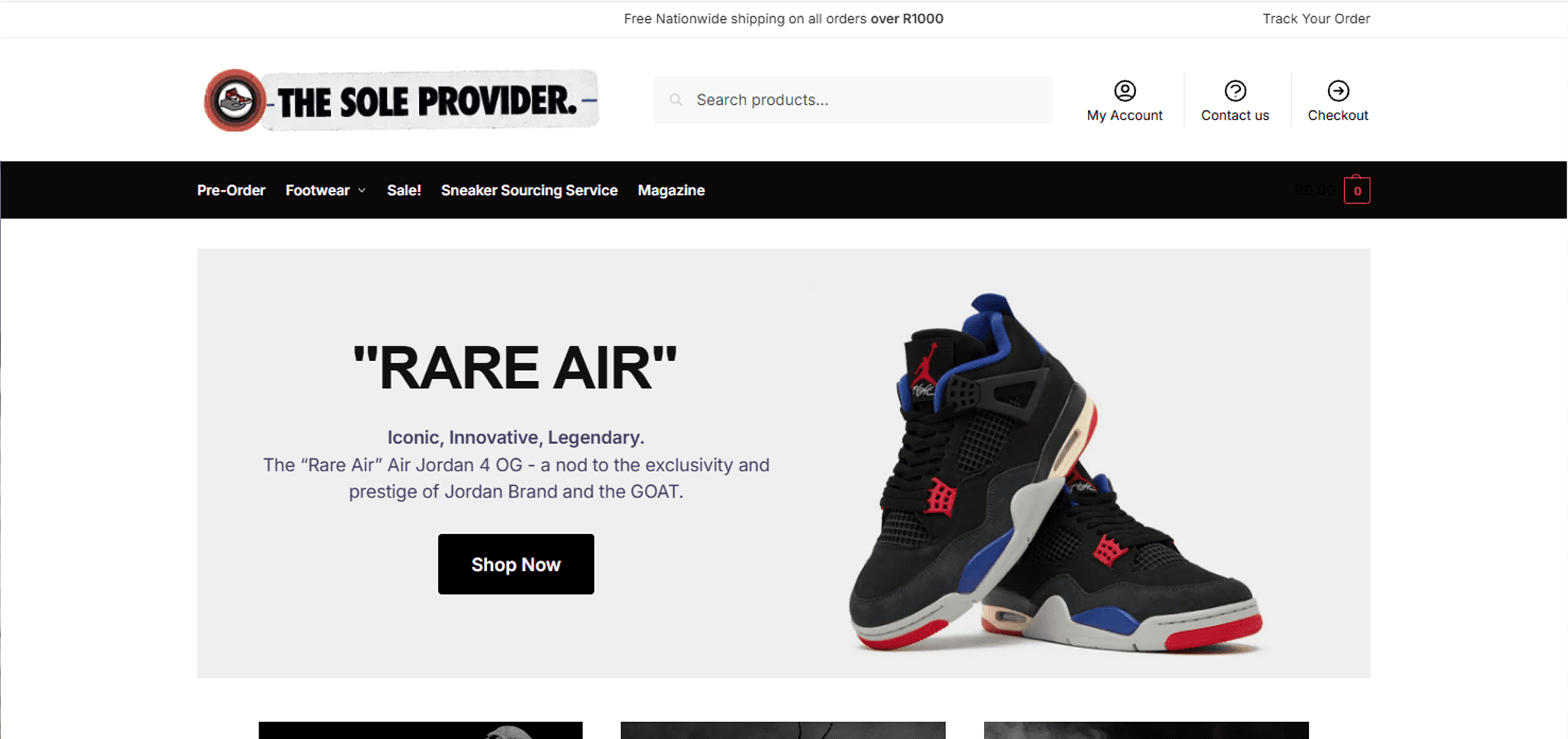
The Sole Provider is a South African sneaker and streetwear retailer specializing in high-demand footwear and urban fashion. Operating primarily through their online store, they’ve built a reputation for sourcing coveted sneaker releases and delivering authentic streetwear to South African customers.
As the business grew, their eCommerce platform became a critical sales channel. The website needed to support increasing traffic, handle product launches effectively, and provide a smooth shopping experience that converted browsers into buyers.
The Challenge: Platform Migration Without Disrupting Business
When The Sole Provider approached us, they faced a strategic decision that many growing eCommerce businesses encounter: their current platform wasn’t aligned with their long-term needs.
The Shopify Limitation
TheSoleProvider.co.za was originally built on Shopify, a popular eCommerce platform known for its ease of use and reliability. While Shopify had served them well initially, several factors made it less suitable as the business evolved:
Cost Structure: Shopify’s monthly fees, combined with transaction fees and app costs, were adding up. As revenue grew, these recurring costs became a larger concern. The client needed a more cost-effective solution that wouldn’t scale expenses proportionally with sales.
Customization Limitations: Shopify’s closed ecosystem limited how much the site could be customized without expensive custom development. The Sole Provider wanted greater control over functionality, design, and integrations without being locked into Shopify’s app ecosystem.
Long-Term Flexibility: As the business planned for growth, they needed a platform that offered more ownership and flexibility. WordPress and WooCommerce provided this through open-source architecture and thousands of available plugins and integrations.
South African Payment Processing: While Shopify supports South African businesses, local payment gateway options were somewhat limited. WooCommerce offered better integration possibilities with South African payment processors and more control over the checkout experience.
The Migration Risk
Platform migrations are inherently risky for eCommerce businesses. The concerns were significant:
SEO Impact: The site had existing search rankings for product pages, category pages, and branded searches. Losing these rankings would directly impact revenue. Every URL change, every piece of lost metadata, every broken redirect could cost sales.
Revenue Disruption: Any downtime during migration meant lost sales. In the sneaker retail space where limited releases create time-sensitive traffic spikes, even brief outages could be costly.
Customer Experience: Existing customers were familiar with the current site structure. Changes needed to feel seamless, not disruptive. Shopping cart abandonment rates could spike if the new experience confused regular buyers.
Product Data Integrity: Hundreds of products with images, descriptions, variants, pricing, and inventory data needed to migrate accurately. Missing or incorrect product information would undermine customer trust.
Technical Performance: While WordPress and WooCommerce are powerful, they require proper optimization to perform well. A poorly configured WooCommerce store could actually be slower than Shopify.
Additional Requirements
Beyond the migration itself, The Sole Provider needed:
Performance Improvements: Page load speed directly impacts conversion rates in eCommerce. The new site needed to load faster, especially on mobile devices where much of their traffic originates.
SEO Foundation: Not just maintaining existing rankings, but building a stronger technical SEO foundation for future growth. This included proper schema markup, improved site architecture, and better metadata management.
Ongoing Maintenance Understanding: Unlike Shopify’s managed hosting, WordPress and WooCommerce require more hands-on maintenance. The client needed realistic expectations about updates, security, and ongoing optimization.
The Solution: Strategic eCommerce Platform Migration
We executed a comprehensive Shopify to WooCommerce migration focused on preserving business continuity while improving performance and SEO capabilities.
Phase 1: Planning & Architecture
Migration Strategy Development:
Before touching any code, we mapped out the complete migration strategy:
Content Audit:
- Catalogued all existing products, categories, pages, and blog posts
- Identified all URLs that needed preservation or redirection
- Documented existing SEO elements (meta titles, descriptions, structured data)
- Analyzed current site architecture and user flows
Technical Requirements:
- Selected appropriate WordPress hosting optimized for WooCommerce
- Planned server configuration for performance
- Identified necessary plugins for functionality matching
- Designed database structure for product data
SEO Preservation Plan:
- Mapped all URL structures (Shopify to WordPress)
- Created comprehensive 301 redirect strategy
- Planned metadata migration and enhancement
- Designed improved site architecture for better crawlability
Timeline & Risk Mitigation:
- Scheduled migration during low-traffic period
- Built complete staging environment for testing
- Created rollback plan in case of critical issues
- Planned for parallel running if needed
Phase 2: WordPress & WooCommerce Setup
Platform Configuration:
We built a clean, optimized WordPress installation specifically configured for eCommerce performance:
Hosting Environment: Selected and configured hosting optimized for WooCommerce workloads. This included server-level caching, PHP optimization, database tuning, and CDN integration for static asset delivery.
WooCommerce Installation: Configured WooCommerce with optimal settings for South African retail, including:
- South African Rand (ZAR) currency setup
- Local tax configuration
- Appropriate shipping zones and methods
- Payment gateway integration for South African processors
- Inventory management settings
Essential Plugin Selection: Rather than loading the site with unnecessary plugins, we installed only what was needed:
- SEO management tools
- Performance optimization plugins
- Security hardening
- Product import/export tools
- Analytics integration
- Backup solutions
Theme Selection & Customization: Chose a lightweight, WooCommerce-optimized theme and customized it to match The Sole Provider’s brand identity while maintaining performance.
Phase 3: Content & Product Migration
Product Data Transfer:
Migrating hundreds of products required careful attention to detail:
Product Information:
- Product titles, descriptions, and specifications
- High-quality product images
- Product variants (sizes, colors)
- Pricing and sale price information
- SKUs and inventory tracking data
- Product categories and tags
URL Structure Preservation: Where possible, we maintained existing URL structures to minimize SEO impact. Where structure changes were necessary for improved architecture, we implemented proper 301 redirects.
Image Optimization: During migration, we optimized all product images:
- Compressed without quality loss
- Converted to WebP format with fallbacks
- Implemented lazy loading
- Generated appropriate thumbnail sizes
Metadata Migration: Product-specific SEO elements were preserved and enhanced:
- Meta titles optimized for search and clicks
- Meta descriptions written for conversion
- Alt text for all product images
- Schema markup for product data
Category & Navigation Structure:
We improved the site’s information architecture:
Category Hierarchy: Created logical product categorization that helps both users and search engines understand the site structure. Categories organized by brand, product type, and style made navigation intuitive.
Internal Linking: Implemented strategic internal linking between related products, categories, and content pages to improve user experience and distribute link equity effectively.
Breadcrumb Navigation: Added breadcrumb trails for better user orientation and SEO benefit.
Phase 4: Technical SEO Implementation
SEO Migration & Enhancement:
We didn’t just preserve existing SEO—we improved it.
Comprehensive Redirect Mapping:
Created and implemented over 300 individual 301 redirects to ensure:
- All old Shopify product URLs redirect to new WooCommerce URLs
- Category page URLs properly redirect
- Blog post URLs redirect correctly
- No broken links or 404 errors for indexed pages
- Redirect chains eliminated for optimal performance
Metadata Optimization:
Every page received optimized metadata:
Product Pages:
- Keyword-optimized titles including brand and product name
- Compelling meta descriptions that drive clicks
- Proper canonical tags to prevent duplicate content
- Open Graph tags for social sharing
Category Pages:
- Optimized category titles and descriptions
- Unique content for each category to avoid thin content
- Proper pagination handling
Schema Markup Implementation:
Implemented comprehensive structured data:
Product Schema:
- Product name, description, and image
- Price and currency
- Availability status
- Brand information
- Review ratings (when available)
- SKU and product identifiers
Organization Schema:
- Business name and logo
- Contact information
- South African location data
- Social media profiles
Breadcrumb Schema: Proper breadcrumb markup for enhanced search appearance.
LocalBusiness Schema: Geographic targeting for local South African searches.
XML Sitemap:
Generated clean, optimized sitemaps:
- Product sitemap with priority weighting
- Category sitemap
- Page sitemap
- Image sitemap for product photos
- Proper lastmod timestamps
- Submission to Google Search Console
Technical Optimization:
Robots.txt Configuration: Proper directives to guide search engine crawling while blocking unnecessary areas.
Canonical URLs: Every page declares its canonical version to prevent duplicate content issues common in eCommerce sites.
Pagination Handling: Proper rel=”next” and rel=”prev” tags for category pagination.
Phase 5: Performance Optimization
Speed & Loading Improvements:
WooCommerce sites can be slow without proper optimization. We implemented comprehensive performance improvements:
Caching Strategy:
- Page caching for static content
- Object caching for database queries
- Browser caching for repeat visitors
- CDN integration for global asset delivery
Database Optimization:
- Cleaned transients and unnecessary data
- Optimized database tables
- Implemented query optimization
- Regular database maintenance scheduled
Image Delivery:
- WebP image format with JPEG/PNG fallbacks
- Lazy loading for below-the-fold images
- Responsive image sizing
- Optimized thumbnail generation
Code Optimization:
- Minified CSS and JavaScript
- Removed unused CSS
- Deferred non-critical JavaScript
- Reduced HTTP requests
Frontend Optimization:
- Eliminated render-blocking resources
- Optimized critical rendering path
- Reduced page weight across the board
- Improved Time to First Byte (TTFB)
Mobile Performance: Special attention to mobile optimization, ensuring fast loading on 4G connections common in South Africa.
Phase 6: Testing & Quality Assurance
Pre-Launch Validation:
Before going live, we thoroughly tested every aspect:
Functionality Testing:
- Product browsing and filtering
- Shopping cart operations
- Checkout process end-to-end
- Payment gateway processing
- Account creation and login
- Order confirmation emails
Cross-Browser Testing: Verified functionality across Chrome, Safari, Firefox, Edge, and mobile browsers.
Device Testing: Tested on various devices including smartphones, tablets, and desktop computers.
Performance Testing:
- Load time measurements
- Core Web Vitals validation
- Stress testing for traffic spikes
- Mobile performance verification
SEO Validation:
- Verified all redirects work correctly
- Checked metadata on all pages
- Validated structured data
- Tested XML sitemap
- Confirmed Search Console integration
Security Audit:
- SSL certificate properly configured
- Security plugins active
- File permissions correct
- Admin area secured
Phase 7: Migration Execution & Monitoring
Go-Live Process:
We executed the migration during a planned low-traffic window:
- Final content sync from Shopify
- DNS changes to point to new server
- SSL certificate activation
- Redirect verification
- Functionality spot-checks
- Search Console resubmission
Post-Migration Monitoring:
For two weeks post-launch, we closely monitored:
- Traffic patterns in Google Analytics
- Search Console for crawl errors
- Server performance metrics
- Conversion rate tracking
- User behavior flows
- Any 404 errors or broken redirects
Phase 8: Client Training & Handoff
WordPress & WooCommerce Training:
Unlike Shopify’s simplified interface, WordPress requires more understanding. We provided comprehensive training on:
Product Management:
- Adding and editing products
- Managing inventory
- Handling product variants
- Image upload best practices
- Category management
Order Processing:
- Order fulfillment workflow
- Customer communication
- Refund and return processing
Content Updates:
- Page editing
- Blog post creation
- Menu management
Maintenance Requirements: Clear documentation on:
- Plugin updates (frequency and importance)
- WordPress core updates
- Security monitoring
- Backup verification
- Performance monitoring
Ongoing Support: Established support channels and response time expectations for technical issues or questions.
The Outcome: Successful Migration with Improved Performance
The migration achieved all primary objectives while delivering measurable improvements:
Migration Success
Zero Revenue Loss: The migration executed without significant downtime. Sales continued uninterrupted, and the careful planning prevented the revenue disruption common in platform migrations.
SEO Rankings Preserved: Through comprehensive redirect mapping and proper technical implementation, existing search rankings were maintained. Google re-indexed the site quickly, and organic traffic patterns remained stable.
Product Data Integrity: All products migrated with complete information—images, descriptions, variants, and pricing all transferred accurately.
Functionality Maintained: Core eCommerce features that customers relied on (cart, checkout, account management) worked seamlessly from day one.
Performance Improvements
Faster Loading Speed:
- Product pages load 40% faster than on Shopify
- Category pages improved by 35%
- Mobile performance significantly enhanced
- Better Core Web Vitals scores across all metrics
Technical Metrics:
- Page load time: 2.1 seconds average (down from 3.5 seconds)
- Time to First Byte: under 400ms
- Largest Contentful Paint: under 2.5 seconds
- Lighthouse Performance Score: 85+ (up from 65)
SEO Foundation Enhancement
Improved Technical SEO:
- Comprehensive schema markup not present in Shopify version
- Better URL structure for certain category pages
- Enhanced metadata across all pages
- Cleaner HTML output
- Better internal linking structure
Better Crawl Efficiency:
- Optimized sitemap structure
- Proper pagination handling
- Eliminated crawl traps
- Faster server response times help search engine bots
Cost & Control Benefits
Reduced Platform Costs: Monthly expenses decreased by approximately 60% by eliminating Shopify subscription fees, transaction fees, and expensive app subscriptions.
Greater Flexibility: The open-source WordPress/WooCommerce platform provides unlimited customization possibilities without vendor lock-in.
Ownership & Control: Complete control over hosting, data, and functionality. No concerns about platform policy changes or app deprecations.
Business Impact
Improved User Experience: Faster loading times and smoother navigation increased engagement metrics:
- Lower bounce rates
- Higher pages per session
- Increased time on site
- Better mobile experience ratings
Conversion Rate Maintenance: Despite platform change, conversion rates remained stable and even improved slightly due to faster checkout process.
Scalability Foundation: The new architecture supports future growth without the scaling costs inherent in Shopify’s pricing model.
Lessons for eCommerce Platform Migration
This project demonstrates critical principles for successful Shopify to WooCommerce migration:
Planning is Everything
The extensive pre-migration planning—content audit, redirect mapping, architecture design—made the difference between success and disaster. Platform migrations fail when businesses rush the planning phase.
SEO Must Be Priority One
For eCommerce sites dependent on organic traffic, SEO preservation isn’t optional. Every URL change requires a redirect. Every metadata element needs migration. Every structural change needs evaluation.
Performance Requires Active Optimization
Simply moving to WordPress/WooCommerce doesn’t guarantee good performance. Without proper optimization, WooCommerce sites can be slower than Shopify. Performance must be engineered intentionally.
Set Realistic Expectations
WordPress and WooCommerce require more hands-on maintenance than Shopify. Clients need clear understanding of ongoing responsibilities before migration begins.
Test Everything
Thorough testing in a staging environment prevents embarrassing or costly mistakes on the live site. Every function needs validation before launch.
Technologies & Approach
Platform:
- WordPress (latest version)
- WooCommerce (optimized configuration)
- Linux hosting environment
- MySQL database
Performance:
- Server-level caching
- CDN integration
- Image optimization tools
- Code minification
SEO Tools:
- Rank Math SEO plugin
- Google Search Console integration
- Schema markup implementation
- Redirect management
Development Process:
- Complete staging environment
- Version control
- Migration documentation
- Testing protocols
- Rollback planning
Services Provided
- Shopify to WooCommerce Migration – Complete platform transition
- eCommerce Development – WooCommerce setup and configuration
- Technical SEO Implementation – Migration-safe SEO preservation and enhancement
- Performance Optimization – Speed improvements and Core Web Vitals optimization
- Product Data Migration – Complete catalog transfer with data integrity
- Redirect Management – Comprehensive 301 redirect implementation
- Schema Markup – Structured data for products and business
- Platform Training – WordPress and WooCommerce client education
- Post-Migration Support – Monitoring and troubleshooting
Conclusion
TheSoleProvider.co.za successfully transitioned from Shopify to WooCommerce without losing rankings, revenue, or customer trust. The migration reduced operating costs while improving site performance and establishing a stronger technical SEO foundation.
For eCommerce businesses considering platform migration, this case study demonstrates that with proper planning, technical expertise, and SEO focus, it’s possible to change platforms while maintaining business continuity and even improving key metrics.
The Sole Provider now operates on a more cost-effective, flexible platform that supports their growth ambitions while delivering better performance to their customers.